Did Financial Aid Give You More Money if You Have a Baby
Final updated: March 2016.
Full reading fourth dimension: xv minutes.
Introduction
Information technology's a cliché that "you can't buy happiness", just at the aforementioned time, financial security is among well-nigh people's top career priorities.ane Moreover, when people are asked what would most ameliorate the quality of their lives, the almost mutual answer is more money.2 What's going on here? Who is correct?
A lot of the research on this question is of remarkably low quality. Merely at that place have been some recent major studies in economics that permit us to make progress. In particular, nosotros at present finally have survey data from hundreds of thousands of people all effectually the globe. We've sifted through the all-time studies available to figure out what's really going on. The truth seems to lie in the center: money does brand you lot happy, but only a picayune. And this has many important implications about merchandise-offs you face up in your life and career.
Summary of main points
- Recent surveys of hundreds of thousands of people, in over 150 countries, show that richer people report beingness more satisfied with their lives overall, but that the richer you lot get, the more than money you need to increase your satisfaction further. This is because people spend coin on the nigh important things first. Someone earning $100,000 per year is only a footling more satisfied than someone earning $fifty,000. The all-time available study plant that each doubling of your income correlated with a life satisfaction 0.five points higher on a scale of 1 to 10.
- If you look at how 'happy' people say they are correct now, the human relationship is weaker. One large written report found people in countries with average incomes of $32,000 were simply 10% happier with their lives than those in countries with average incomes of just $ii,000; another within the Usa could find no consequence above a $40,000 income for a single person.
- Moreover, some and perchance fifty-fifty near of this relationship is not causal. For example, healthier people will be both happier and capable of earning more. This ways the effect of gaining extra money on your happiness is weaker than the above correlations advise. Unfortunately, how much of the above relationships are caused past money making people happier is still not known with confidence.
- Once you get to an individual income of around $twoscore,000, other factors, such as health, relationships and a sense of purpose, seem far more important than income. So our recommendation is not to focus on earning more than this (insofar as y'all want to become happy, anyhow).
- Nevertheless, you may proceeds from earning more than that if: you have dependents, you care virtually coin more than other people, or you alive in an area with an unusually high price of living.
- Giving coin to someone living on $1,000 per year in the developing world will do far more to improve their lives than giving the same corporeality to someone earning $25,000. The correlations above suggest that it will be virtually 25 times more valuable. If y'all want to help people, this is a major reason to focus on international poverty rather than helping the relatively poor in richer countries.
- Giving some money to clemency is unlikely to make you less happy, and may well make you lot happier.
Are richer people more satisfied with their lives?
Thinking about it for a moment, you'd expect that the richer y'all are, the more extra money yous demand to farther increase your happiness.
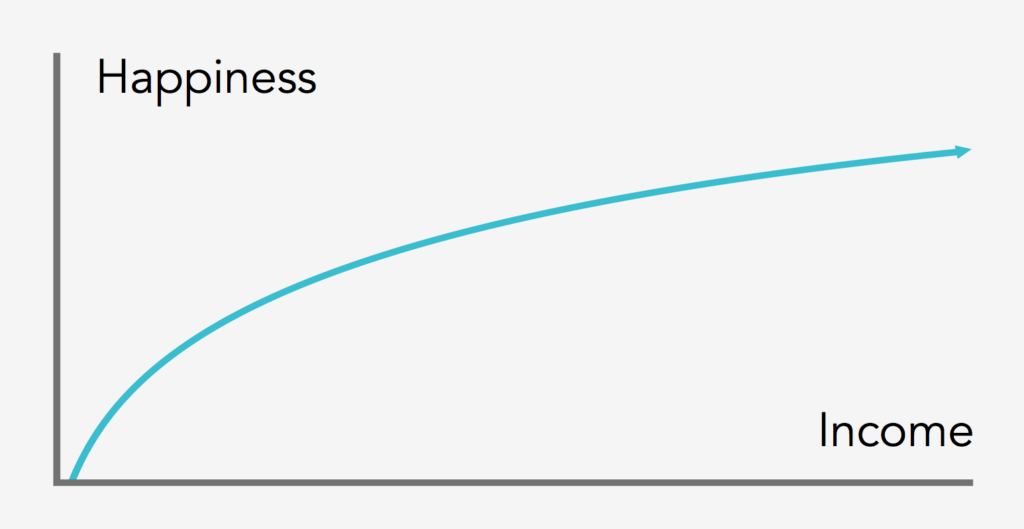
If y'all're earning $10,000 a twelvemonth, and yous get an extra $ane,000, you're probably going to use information technology on something pretty important, like making rent, which will make a big difference to your happiness. Just if you're earning $100,000 per year, you'll hardly observe an extra $1,000. Maybe you'll just use it to swallow out a fleck more. In other words, yous'd expect the relationship to be diminishing. If you draw out a graph of income against happiness, it'll look a bit like the graph below. This is what every economist, philosopher and psychologist who works on this topic expects to see.
At some indicate yous cease up spending coin on stuff that doesn't make much difference. For case:

(That's literally a roll of toilet paper made of gilded that some people bought.)
The interesting question is how fast that happens. It may exist that at centre-class incomes extra coin still makes you significantly happier. Or peradventure after that point actress income has no discernible impact at all.
I way to figure this out is to ask lots of people all effectually the globe how much they earn and how satisfied they are with their lives. A typical question of this kind from the 'World Values Survey' is:
"All things considered, how satisfied are you with your life as a whole these days?: one (dissatisfied) – 10 (very satisfied)."
In the 70s and 80s, it was widely thought by psychologists that after a sure point, there was no relationship between income and life satisfaction, at least in wealthier countries.
Today, larger and more rigorous studies oasis't borne out that result. As you get richer, you need a lot more money to make yous more satisfied, just in that location's no maximum level of income beyond which more than seems to contribute nothing.
The best report we could detect is this one by famous economists Betsy Stevenson and Justin Wolfers. Information technology draws on polling data from hundreds of thousands of people in 166 countries and found that people in richer countries reported being more satisfied with their lives than those in poorer countries, and that within a land, richer people likewise reported being more satisfied than those with lower incomes.
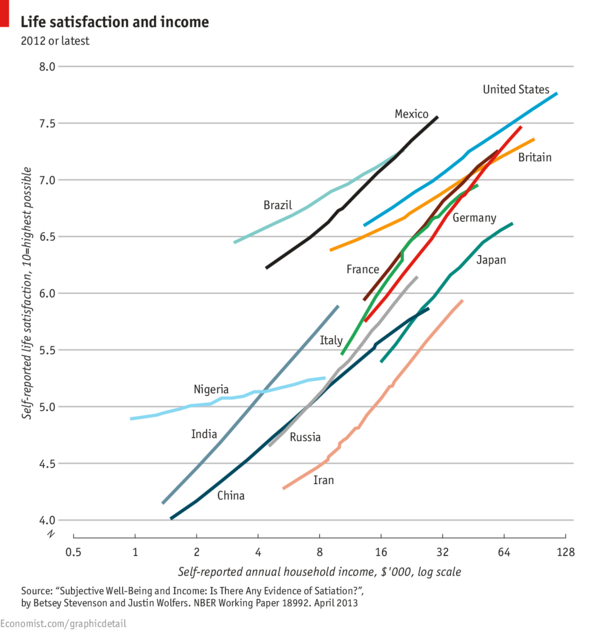
As you lot can see, this survey plant a clear straight-line relationship between income and happiness both within and between countries. The lines are straight rather than curved considering each increase on the bottom of the axis indicates a doubling of income.
Roughly, what this means is that if you lot double your income, you gain about half a point on a calibration of 1 to 10 of life satisfaction. More precisely, this is a called a logarithmic relationship.
Annotation that this is just an association at this point – we discuss whether higher income is actually causing people to get more satisfied below.
According to this survey data, a typical person with a household income of $two,000 rates their life satisfaction at around 4.ii out of 10. A typical person with a household income of $64,000 rates their life satisfaction at 7.2 out of 10.3
In the past, with only inconsistent polls available in a small number of countries, this relationship was much less clear, causing researchers to think there was no relationship between satisfaction and income. For more on the controversy virtually this today you tin skip to Appendix I.
OK, but are richer people happier?
There's more evidence for a maximum useful level of income if instead of asking people how their life is going overall, nosotros enquire them how they experience right now or felt yesterday.
For case, this study by Nobel prize winners Daniel Kahneman and Angus Deaton, relied on a phone poll that asked hundreds of thousands of Americans how they felt in the post-obit means:iv
- Positive bear upon – "were you happy yesterday?"
- Low stress – "did y'all experience stressed yesterday?"
- Not blueish – "did you feel sad yesterday?"
- Ladder – "how satisfied are you with your life overall?"
Hither's the upshot:
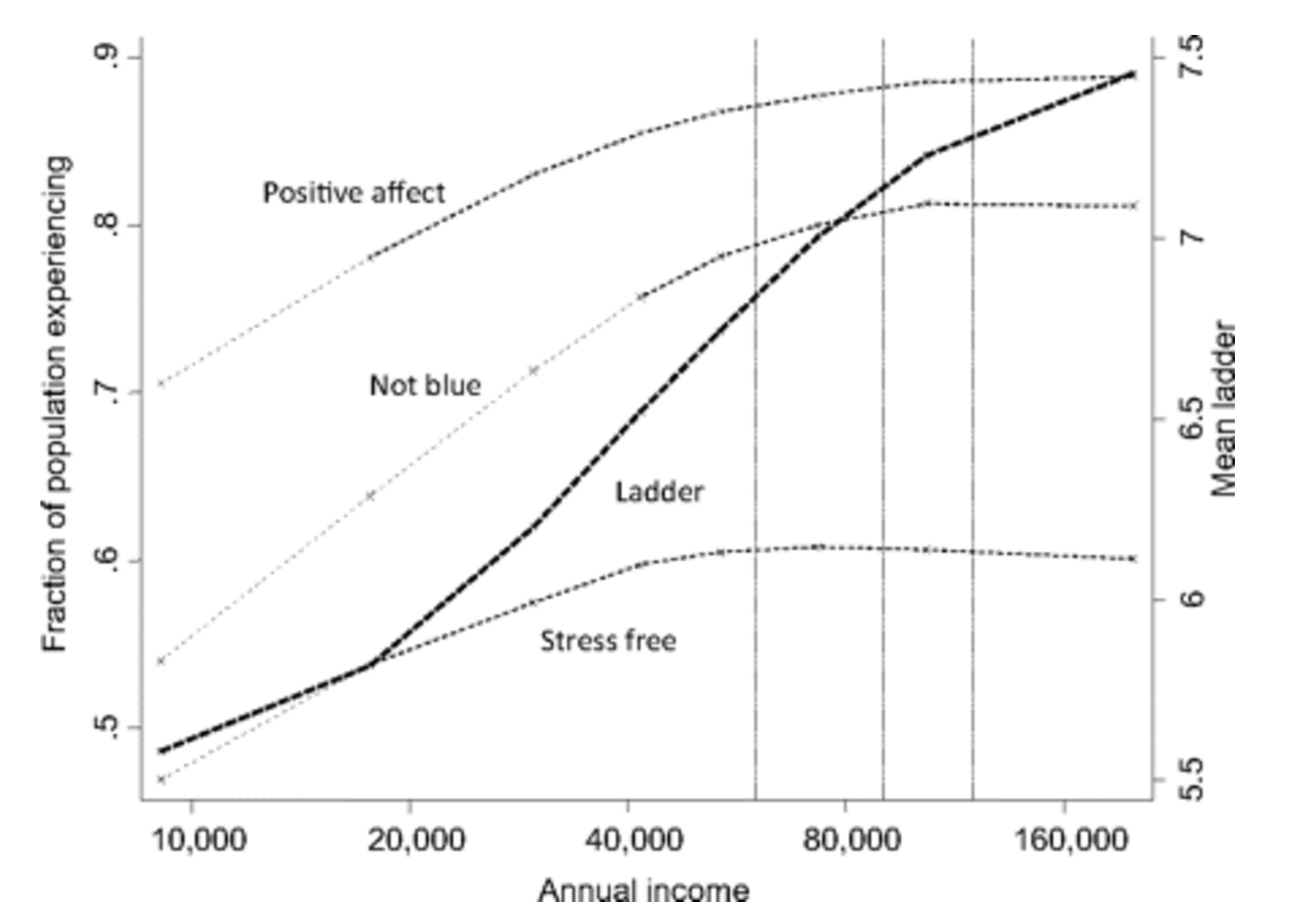
Once again, the scale at the bottom doubles with each increment.
You can see that the "ladder" of life satisfaction is roughly directly all the way upwards, only as we found before.
Even so, the other three lines start to flatten around $l,000, and are completely flat by $75,000. This means that extra income had no relationship with how happy, sad and stressed people felt after this point.
Moreover, notation that this is $l-75,000 of household income. That's equivalent to an individual income of more similar $26-40,000 if you're single and not supporting kids.v
Non all studies find that money stops having whatsoever impact. For instance, another enormous data analysis past Daniel Sacks, Justin Wolfers and Betsy Stevenson found that happiness continued to improve in countries with higher incomes – or at least there was no articulate levelling off (see figure beneath).6
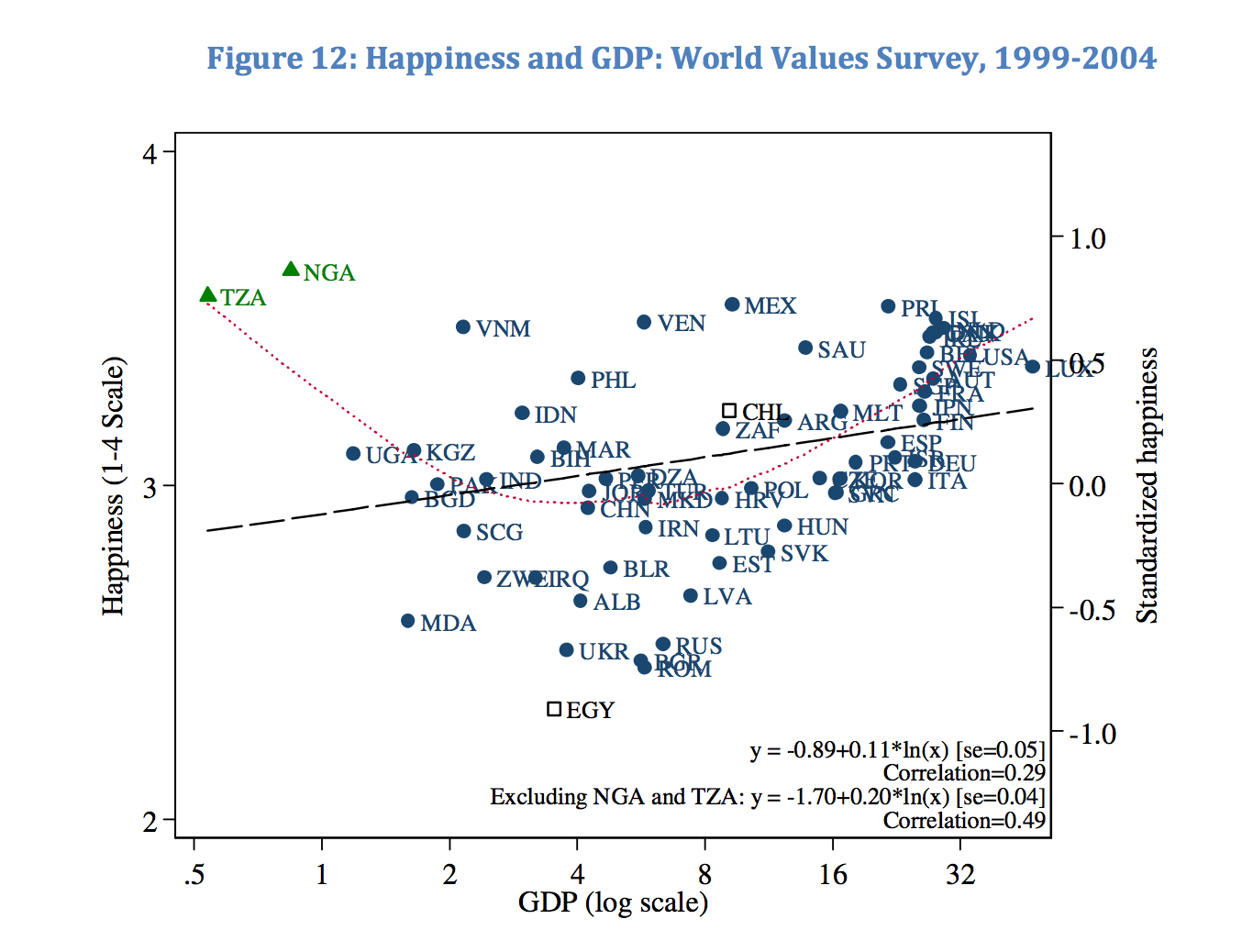
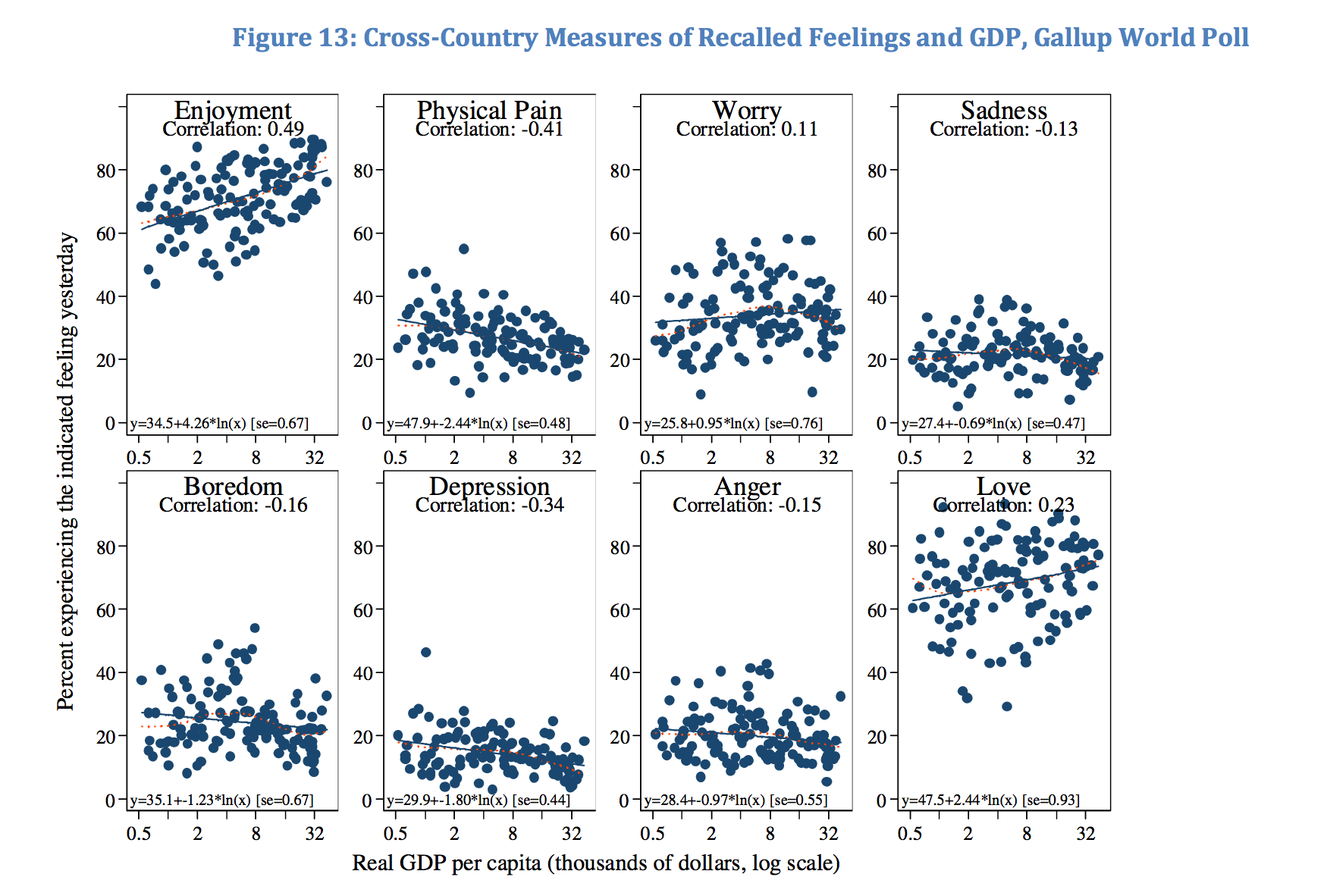
People in richer countries were more likely to recall feeling 'enjoyment' or love yesterday, and less likely to feel 'depression', or 'physical pain' despite being older (see the figure beneath).
People in richer countries were also a scrap more than probable to report existence consistently treated with respect, having proficient tasting food, smile or laughing a lot, and being gratis to cull how they spend their time (see the figure below).vii
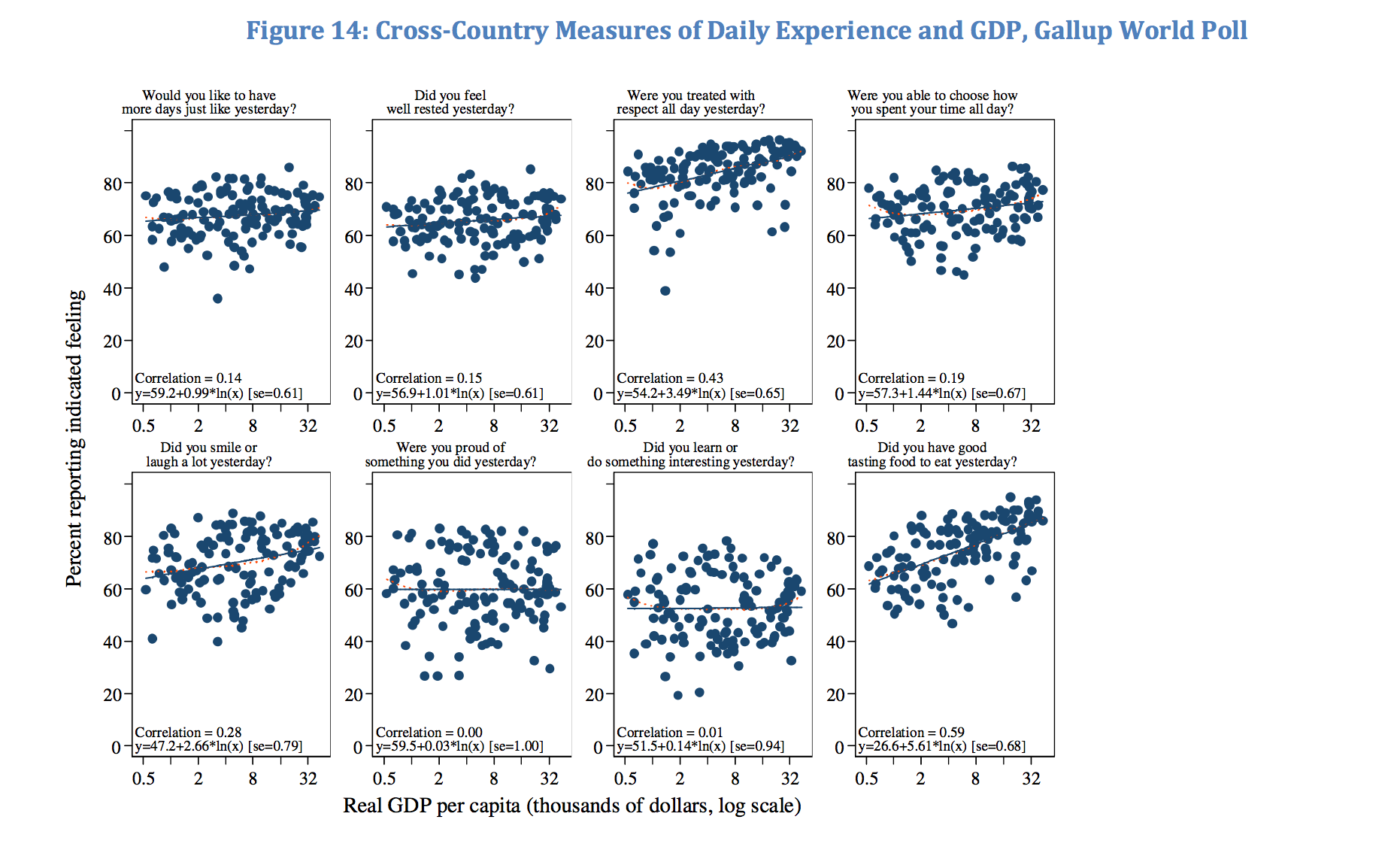
But but scanning the data you lot tin see that these associations, while real, are quite weak considering the enormous range of income across the sample. Raising income 16-fold, from $ii,000 to $32,000, moved reported happiness from iii.0/four to 3.iii/4.8 A 64-fold increase in income, from $500 to $32,000, increased the probability of recalling feeling enjoyment or eating tasty food yesterday from around 60% to 80%. A 64-fold increase in income only raised the likelihood of feeling 'dearest' yesterday from 63% to 73%. Much of our everyday human being experiences are just non affected much by money. In other words:
In other studies we looked at, overall life evaluation always showed the strongest relationship with income. If you ask people how happy they feel today, or felt yesterday the relationship becomes more tenuous.9
What can make sense of these results?
Nosotros guess the fundamental factor is the one we noted at the beginning – you take the best opportunities to invest in your happiness first, and then equally you get more money, it becomes harder and harder to buy more happiness. Eventually the issue of additional income of happiness becomes negligible relative to other factors.
There could be other reasons for a weak human relationship. For case, 1 mode to earn more than money is to work longer hours in a job few other people want to practise. Perchance the unhappiness acquired by these actress hours at work offsets whatever y'all gain from the extra income. It'southward a case of mo' money, mo' problems.
At that place'south some bear witness for this idea. This meta-analysis of over 100 studies found only a very weak relationship between pay and job satisfaction.10 Some kinds of jobs are depression-paying precisely because they are satisfying. For example, if didactics weren't fulfilling, salaries would accept to be higher to convince enough people to become teachers.
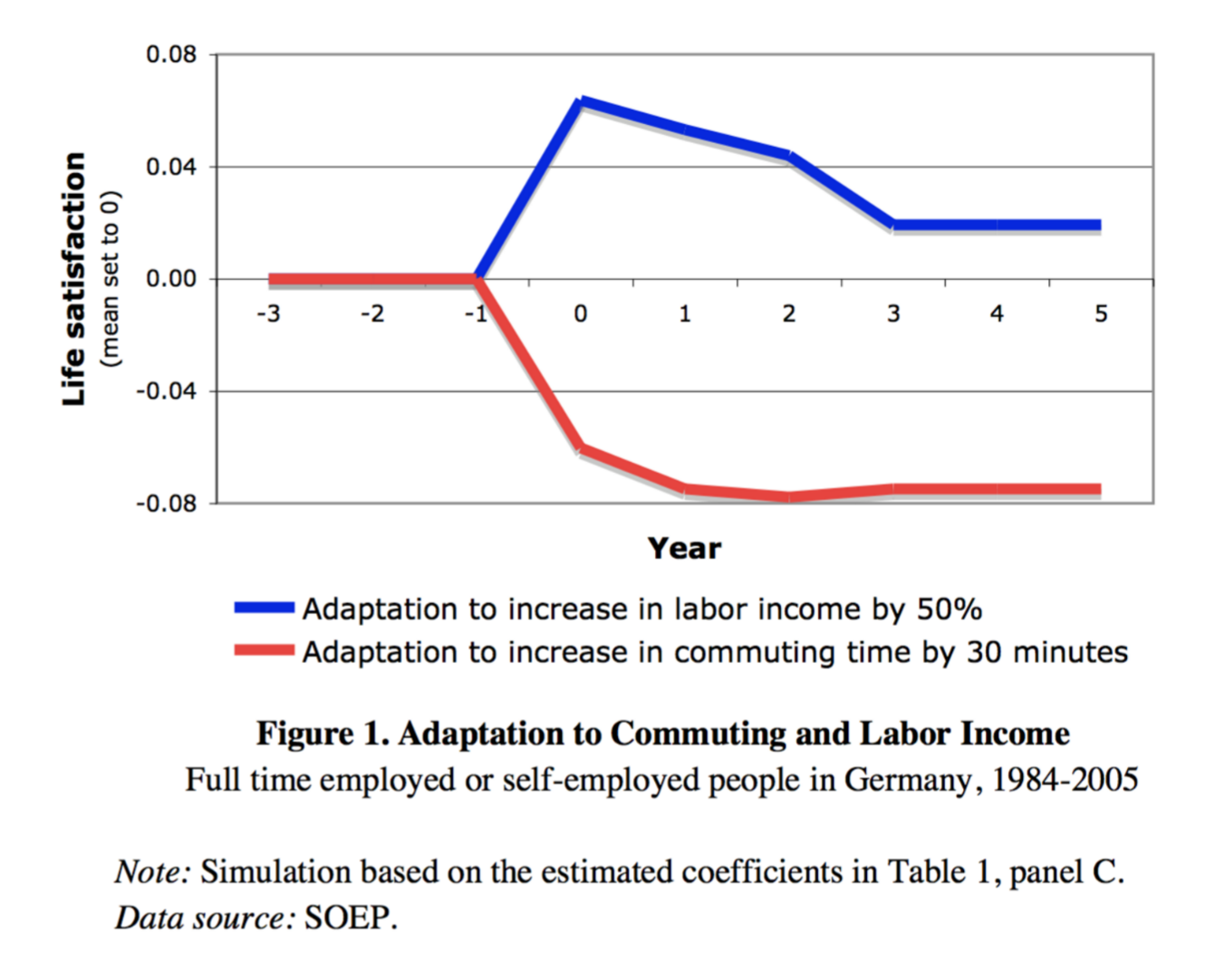
Some other factor is that we readily adapt to having more money. If you just have champagne once a year, it'southward a special occasion. But to quote more Biggie, if "we sip champagne when we thirst-ay", information technology's no big deal. This is called the "hedonic treadmill". This is particularly true when we spend money on material appurtenances, like fancy clothes, which we chop-chop get used to.11 Moreover, we persistently underestimate how much we can adapt, and then expect coin to thing more than it does.12
However, there are some things we can't arrange to, which explains why there remains some relationship betwixt income and happiness even among the rich. 1 example is that long commutes make people unhappy – and they never get used to them (see the figure below).13 More money can too assist you take more than interesting, varied experiences and relationships, which are of import likewise.11
How come up life satisfaction seems to increase more steeply with income than twenty-four hours-to-day happiness? Here's a likely caption. If someone asks you whether you are in physical pain, it's easy to check and give a meaningful answer. But if someone asks you lot on the phone how satisfied you are with your life, all things considered, on a scale of one to 10… information technology can be hard to say. As you don't actually know how satisfied you are on boilerplate, and you lot have to answer quickly, people are inclined to substitute in its identify a related question that is easier to reply. A natural option is 'how much money am I making relative to others?', or 'how well is my career going?'. This widely observed phenomenon is called attribute commutation past psychologists.
In this respect experience sampling is superior because it avoids a range of possible biases in people's perception and recollection of their life.14 All the same, life satisfaction passes several tests for existence a practiced psychological measure (for instance, it is stable over time and predicts future behaviour) so shouldn't be disregarded.15
And so would making more than coin make yous happier?
And so far we've merely looked at the correlation between income and happiness, but correlation doesn't imply causation. As Stevenson and Wolfers remark:
We should note that we have focused on establishing the magnitude of the relationship between subjective well-beingness and income, rather than disentangling causality from correlation. The causal bear on of income on individual or national subjective well-beingness, and the mechanisms past which income raises subjective well-being, remain open up and important questions.
Information technology could be that in that location'south some other factor that causes both happiness and income. If this is true, boosting your income won't boost your happiness. For instance, maybe healthier people are both happier and able to earn more because they accept more than free energy. Or maybe happiness increases your income because happier people make better colleagues.
If these other connections exist, and they probably do, making an effort to earn more money won't increase your happiness as much as you'd hope from the to a higher place correlations alone.
So, if the question is "if I earn more than coin, will I be happier?", then the human relationship is likely weaker than what we've seen above.
And the human relationship higher up was already pretty weak: If you already earn over $40,000, and so you need to gain an extra $40,000 per yr simply to proceeds 0.5 on a 10 indicate calibration of life satisfaction. You tin expect little if whatsoever noticeable outcome on solar day-to-solar day happiness, stress or sadness. That'southward a lot of income for a limited gain.
What about the possibility that people who earn more are happier because of their money, only this is counteracted by them having to work longer hours in less pleasant jobs? If that'southward what's going on, winning the lottery would brand you happier, merely choosing a college paying chore wouldn't.
Then, what nigh lottery winners? When people write nearly income and happiness they always mention this study that supposedly shows lottery winners were no happier a yr or ii after winning. This would be good evidence that at that place'south almost no relationship between income and happiness, even if you could get the coin without having to do any actress work.
However, we went and read the original study, and plant that actually the lottery winners were happier – they reported their happiness equally iv (out of half-dozen) compared to 3.82 for the control grouping.16
But the real problem is that the written report had a tiny sample: in that location were only 22 winners. This was so small – and the control grouping so inappropriately selected – that the authors themselves didn't believe they had yet discovered much. Unfortunately, the story was too adept for people to bother fact checking.
(This is likewise the newspaper you lot might have heard cited proverb paraplegics are no less happy than anyone else – this is nonsense for the same reason. In fact paraplegics rated their general happiness as 2.96, much lower than others.)
Newer studies with larger samples have generally institute that lottery winners seem a picayune improve off – at least subsequently their family and friends stop asking them for money. Unfortunately, it's difficult to say much because i) the samples are usually modest, two) the winnings are ofttimes also small, and iii) the outcome measures all differ from one another, and from the papers above.17 eighteen xix xx 21 22
So in the cease, what testify we tin get almost lottery winners supports what we already thought: more income makes you happier, but just a little.
How practise these figures apply to me?
The figures above are based on surveying a cross-section of people in a state. To customize the $40,000 threshold for yourself, you might desire to make the following adjustments:
- The $40,000 figure was from 2009. Due to aggrandizement, it's more than similar $45,000 in 2016.
- Add together $20,000 per dependent who does not piece of work that you fully back up.
- Add 50% if you alive in an expensive city (east.g. NY, SF), or subtract xxx% if y'all live somewhere cheap (east.g. rural Tennessee). Y'all tin detect cost of living calculations online, like this 1.
- Add more than if you're particularly motivated by money (or subtract some if yous accept frugal tastes).
- Add five-10% in gild to be able to salvage plenty for retirement (or all the same much you lot personally need to save in guild to be able to maintain the standard of living described above). It's true the people in the surveys above were saving for retirement, but we suspect non enough.
The average college graduate in the United States earns $77,000 per year over his or her life, while the boilerplate Ivy League graduate earns over $110,000.23 The upshot is that if y'all're a college graduate in the U.South. (or a like state), then you lot'll likely terminate up well into the range where more than income has almost no effect on your happiness.
Are there exceptions to this general dominion?
The story might be different if you care nigh money more than about people. If that's truthful there could be opportunities to proceeds money that wouldn't be worth it for most people, but are for you lot.
There'due south empirical back up for this. A small percentage of people say making money is a top priority for them at the get-go of their careers, and these people practise turn out to exist significantly more satisfied if they continue to make a lot of it.24 Perhaps this is because they savour spending money more others, or peradventure information technology's just that checking their income is how they track their success. Unfortunately, people whose main goals crave earning money are also less satisfied with their lives on average.
If you want to back up more financial dependents, you will demand to earn more before the income-happiness human relationship weakens in the manner described to a higher place. Besides, if you live somewhere with an unusually high toll of living, y'all tin scale upwardly the figures at which money stops helping. Finally, if your friends are becoming wealthy and yous want to continue to socialise with them in expensive places, money may also be more valuable for you, though we don't know of whatever specific studies on this.
Conversely, if none of those apply, actress income may practise even less for your happiness than these amass surveys propose.
How much does income affair relative to other factors?
If you're educated and in a rich country then there are other factors that will affect your happiness and satisfaction much more than extra income.
- Ball & Chernova summate that for the median single individual, the happiness boost produced past marriage is matched but past a 767% increase in absolute income, or by an increment in relative income from the 50th to the 88th percentile.25
- They likewise constitute the boost associated with moving from a health rating of 3 to iv (when health is scored from i to 5) is matched only by a half dozen,531% increase in absolute income, or by a move from the 50th to the 100th percentile in relative income.
- Beingness widowed (equally a woman) or losing your job (as a human) appears to reduce life satisfaction by about 0.5 points, on a calibration of one-7. Using our estimates above, this would be the same as having your income fall or ascent by two thirds.26
- Having a close friend get happy besides seems to increment your chance of being happy a great deal (at to the lowest degree ten%).27
What does this hateful for your career pick?
We think the message is articulate: if you want a satisfying career, once you're earning above about $xl,000, don't focus on earning more money. Instead, focus on the factors we recommend in our article on how to find fulfilling piece of work.
This is widely accepted by experts in the field. For example: Timothy Guess, professor of direction at the Academy of Notre Matriarch, suggests that if you ultimately care about having a task that's satisfying:
You would be meliorate off weighing other chore attributes higher than pay.
(Though note the possible infrequent conditions to a higher place.)
What does this hateful for having a positive bear on on the world?
Coin can go much further in the poorest countries. It's clear that higher incomes do good people in serious poverty. If the relationship between income and satisfaction is logarithmic, or even more sharply failing, you need 50-100 times as much coin to increase the satisfaction and happiness of an educated American as that of someone in the poorest billion people.28
This is 1 of the main reasons we think that if you desire to help people alive today, it's important to focus on the effects your actions accept on those in the developing globe. That's true whether we're talking near giving to charity, enacting policy reform, or setting up a social enterprise. Their welfare is simply much more responsive to changes in income.29
You may accept greater cognition of your local community, but that'due south probably non enough to brand upward for the fact that your resources could get ane hundred times as far if you focus on the very poorest people. And fortunately in that location is high quality inquiry you can rely on to know what actually works in the developing world. I of the top opportunities is just directly giving money to the very poor.
If you gave coin to charity, would it brand you more satisfied or less?
The results in a higher place propose that if you're a professional in a rich country, having a lower income won't brand yous much less happy. As a upshot the personal costs of donating to charity are likewise likely small.
Moreover, donating coin is not at all the same as not earning it in the beginning place. Someone with an income that's low relative to what they aspire to may feel unsuccessful, and therefore unsatisfied with their life. Only if you earn a expert salary and donate a big clamper, you probably won't feel that manner. On the contrary – you'll see yourself every bit successfully striving to make your mark on the world.
At that place's considerable evidence that acts of altruism make us happier, more satisfied and even healthier. This includes acts of clemency, too as other ways of helping people such as ownership gifts for friends and family.
This means that donating money could easily make you happier than spending it on yourself.
For instance:
Imagine the following scenario. Yous are a participant in a psychological experiment: y'all are given an envelope containing a small sum of money, which you are asked to spend within 24 hours. The experimenter tin assign you to ane of atmospheric condition: she can require that y'all spend the money on yourself (paying a bill or buying yourself a treat) or she can crave that you spend the money on others (buying a nowadays for someone or donating the money to clemency).
…the experimenters found that subjects in the prosocial spending condition reported greater happiness after spending their windfall than did those in the personal spending status. This was not an isolated consequence. Dunn et al. as well conducted a longitudinal report of sixteen employees at a Boston based company who received a profit-sharing bonus, finding that those who devoted more of their bonus to prosocial spending experienced greater happiness as a result of spending their windfall; a cantankerous-exclusive report of a representative sample of Americans also establish greater prosocial spending correlated with significantly greater happiness, while personal spending turned out to be unrelated to happiness.
Aknin et al. examined survey-data from 136 countries gathered by the Gallup Arrangement, to meet whether ratings of subjective wellbeing were positively correlated with donating to clemency. Controlling for household income, information technology was found, in 122 of the 136 countries, that in that location is a positive correlation between subjective wellbeing and answering Yes to the question 'Have yous donated money to charity in the last month?' On boilerplate, it was institute, "donating to charity has a similar relationship to subjective wellbeing as a doubling of household income."
Nosotros worry that concluding effect is confounded by religion: membership of a church building both predicts charitable giving and higher welfare. Just there's skillful reason to think that giving away money will lower your subjective well-beingness significantly less than non having it in the first place.
Of course, this can't justify any level of donations. As is the case for everything else nosotros spend our money on, the selfish benefits nosotros get from donations will experience failing marginal returns: giving $two,000 won't be twice equally fulfilling as giving $1,000. And, in accord with the logarithmic returns to spending described above, the more coin you lot donate, the more valuable is each incremental dollar of other personal consumption y'all're surrender.
Still, I'd expect a moderate level of giving to lead to a similarly happy life as no giving, especially if yous make your donations frequent and highly salient, then that yous can savour the satisfaction that comes forth with assertive you're helping others.
The bottom line
Y'all accept probably heard both from people who say earning a skilful income is both incredibly of import, and non of import at all. As is often the case when you await carefully at the testify, the truth seems to exist somewhere in between.
Unfortunately, existing research is non good enough to say for sure what impact a randomly assigned increase in income has on someone's welfare. Hopefully more thorough research on lottery winners will answer this question in the futurity. Simply until then we at least have a lot of information on how people who earn both a lot and a little report feeling almost their lives.
If you're poor, having fifty-fifty small amounts of extra coin is associated with pregnant gains in welfare. People in very poor countries report low levels of satisfaction with their lives, though their day-to-day happiness is surprisingly resilient.
But almost of our readers are university graduates in rich countries, the group that is to the lowest degree likely to do good from higher income. For them, making a meaningful contribution to their society and having skillful relationships with friends and family are likely to do them more good than a higher paying chore. Inasmuch as earning more than ways sacrificing these things information technology'southward a very questionable trade.
If yous'd like to learn more about how to have a career that makes you both happy and fulfilled sign up to our newsletter and we'll update y'all on our latest research each month.
You tin can as well proceed reading our guide to finding a career that makes you truly happy.
Appendix I – But I've e'er been told we but look at relative rather than absolute income?
This remains the source of some controversy, but we recollect the answer is that nosotros care virtually both accented and relative income.
You may have heard of the 'Easterlin Paradox': why don't people get much happier when their country becomes richer? The popular caption in the 70s and 80s was this: people are briefly happy when their income rises, and happier when they are richer than others effectually them, just don't value information technology in the long term when their state as a whole becomes richer.30
The findings in the post above cast serious doubt on whether there is any paradox to explicate. People in richer countries are somewhat more than satisfied.
But Easterlin, who is now xc and has spent much of his life studying this apparent paradox, was not convinced by this data. He published two papers in response, attempting to show that how quickly a country gets richer doesn't correlate with how quickly information technology gets satisfied.31 32 Easterlin believed the error being fabricated by others was:
In the present analysis we demonstrate that these conflicting results arise chiefly from confusing a brusque-term positive happiness – income association, due to fluctuations in macroeconomic atmospheric condition, with the long-term human relationship. We advise, speculatively, that this disparity betwixt the short and long-term association is due to the social psychological phenomenon of "loss disfavor".
In response, Wolfers and Stevenson updated their newspaper to expect at how economical growth relates to satisfaction growth over the longest timescales they could analyse.3 33 Examining the figures in their paper, the two practice seem to move together, though there'south a lot of other variation. This is to be expected. When yous effort to chronicle growth rates in two things, there is a lot of room for measurement error: in baseline income, last income, baseline satisfaction, and final satisfaction. You measure out all of these imperfectly, creating a lot of dissonance that obscures whatever shared motility they have. Furthermore, no one claims economic growth is the just, or even most important thing, determining shifts in happiness.
Wolfers and Stevenson explain the disagreement this way:
…you should never confuse absence of evidence with testify of absenteeism. Easterlin'south fault is to conclude that when a correlation is statistically insignificant, it must be zero. But if you put together a dataset with only a few countries in information technology – or in Easterlin'south analysis, take a dataset with lots of countries, but throw abroad a bunch of it, and discard inconvenient observations – so you'll typically find statistically insignificant results. This is even more than problematic when yous employ statistical techniques that don't excerpt all of the information from your information. Think near it this way: if you flip a coin three times, and it comes up heads all three times, you still don't have much reason to recollect that the money is biased. Merely it would be airheaded to say, "there's no compelling evidence that the money is biased, so it must be fair." However that'southward Easterlin's logic.
Nobel Prize winner Angus Deaton, by contrast, finds some evidence that relative income matters for 'happiness', but doesn't for satisfaction.34 He comments:
The most famous [unresolved puzzle] is the Easterlin paradox that in spite of the positive effect of income on life evaluation and on happiness, there appears to have been lilliputian result of economical growth. That in that location is a paradox at all has been robustly challenged by Daniel Sacks, Betsey Stevenson, and Justin Wolfers (2012), and Easterlin's counter-show rests heavily on long-run Chinese data of dubious comparability. This literature typically does non make the distinction between evaluative and hedonic measures that is so of import hither.
As an aside, one paper attempts to explain the failure of Chinese happiness to ascent with reference to much higher air pollution.35
This question isn't fully resolved, only we're more than convinced by Wolfers and Stevenson'south latest (draft) newspaper on the topic, which shows a combination of positive and neutral relationships and offers several explanations for why others take non constitute the same results.36 The arguments come down to methodological details that are catchy to explain, so if you'd like to explore them I recommend reading the give-and-take section of the newspaper.
There's besides a mutual sense argument that we find compelling: if richer countries are more satisfied than poorer ones, which seems to be the case, it would exist remarkable if countries didn't get eventually more satisfied after they got richer, whatsoever the crusade of the relationship between them. I suspect past studies were just non skillful enough to pick up the effect.
Unfortunately well-nigh all of this appendix concerns income and satisfaction. Given that the income and happiness relationship is weaker to start with, information technology wouldn't surprise me if the unpleasant aspects of economical growth, such every bit pollution, made economic development a pretty ineffective way to increase day-to-twenty-four hour period happiness – at least until countries had been wealthy long enough to fix up those problems and invest their college income in other changes that make them happy.37 Unfortunately, the data on this question is more limited and hasn't been the focus of so much research.
Enjoy this? There's much more than where that came from.
Bring together our newsletter and become updates on our latest research:
Source: https://80000hours.org/articles/money-and-happiness/
0 Response to "Did Financial Aid Give You More Money if You Have a Baby"
Post a Comment